But the good news is also honest: if you do a few basic things consistently, it's possible to see a change within the first few weeks and do it in a way that your body and mind can keep up.
In this guide, you will get:
- a realistic definition of what “quick” actually means
- a clear framework: nutrition, exercise, daily movement, and sleep
- a 7-day kickstart plan to begin today
⚠️ Safety First: If you are pregnant or breastfeeding, have a history of eating disorders, a chronic illness such as diabetes, thyroid disease, or heart disease, or are taking medications that affect appetite or weight, consult your doctor before making major changes.
What does “quick” mean in the context of healthy weight loss?
“Weight drops quickly” sounds good, but most people actually want two things at once:
- for the weight to move
- for the result to last
It's precisely because of sustainability that the U.S. Centers for Disease Control emphasizes that gradual weight loss, about 1-2 pounds per week, is more often sustainable than a very rapid pace (CDC “Steps for Losing Weight”).
The NHS states the same idea from another angle: avoid crash diets and build habits that you can actually maintain (NHS “Tips to help you lose weight”).
Practical interpretation:
- “Quick and healthy” = moderate but consistent deficit
- the focus is on reducing fat mass, not just the number on the scale
How to lose weight quickly and healthily: calorie deficit without starvation
Weight loss is based on one simple principle: you consume, on average, less energy than you expend. The CDC states it directly: body fat decreases when a deficit is created, supported by both diet and exercise (CDC “Physical Activity and Your Weight”).
Here are two mistakes to avoid:
- Too few calories. In the Estonian context, TAI nutrition expert Tagli Pitsi warns that very low energy intake makes it difficult to get essential nutrients — and this can jeopardize health and, ultimately, motivation (toitumine.ee advice on weight).
- “I exercise, so I can eat anything.” Exercise helps a lot, but if calories are constantly in surplus, the results will be meager.
If you want to estimate your deficit without a headache, start by using the Trenniekspert calorie calculator and aim for a small, realistic step, such as reducing portion sizes and 20–30 minutes of walking per day.
Key Takeaway: Healthy weight loss is not “eat less and suffer more” — it's “create a deficit smartly so you can maintain it.”
Food that keeps you full: protein + fiber + simple swaps
If you want to lose weight and still function — work, family, sleep — the key to nutrition isn't a “perfect menu.” The key is satiety, and often, increasing protein intake along with fiber helps the most here.
In simple terms: protein-rich foods tend to keep you full longer and help preserve muscle better during weight loss. For example, Harvard Health writes that protein can help keep hunger under control and support muscle preservation during weight loss (Harvard Health). The Mayo Clinic also emphasizes a similar idea, stating that higher protein foods can help you feel full longer and maintain muscle mass, which makes maintaining a deficit easier (Mayo Clinic).
1) Include protein in every meal
Protein helps keep you full longer and supports muscle mass maintenance, which is especially important when you're in a deficit. This fits well with an approach many associate with high-protein diets without having to go to extremes.
Practical choices:
- cottage cheese, curd cheese, Greek yogurt
- eggs
- chicken, fish, legumes
Practical tip for it to truly work: combine protein with something crunchy or voluminous, such as vegetables, salad, fruit, or whole grains. This makes it easier to maintain a deficit without gnawing hunger.
Simple ideas without counting grams:
- Greek yogurt + berries + a handful of nuts
- curd cheese + fruit or cinnamon + a couple of whole-grain biscuits
- eggs + tomato/cucumber + rye bread
- chicken/fish + large salad + potato/rice
- legume salad with chickpeas or beans + vegetables + olive oil
- “protein snack” ready for the evening: yogurt or curd cheese in the fridge, so sweet cravings don't dictate choices
2) Build a “half-plate” of vegetables
Fiber and volume do their job: hunger is reduced, and eating control is easier.
3) Make 2 simple swaps, not 20 ideal rules
The NHS recommends, among other things:
- swap sugary drinks for water
- don't skip meals, as this often leads to snacking
- read information on packaging and make more informed choices
Exercise that helps lose fat and maintain muscle: strength + cardio + NEAT
If you're looking for a good balance, think this way: strength training for weight loss helps preserve muscle and keep the body in shape, while cardio and daily movement add to calorie expenditure.
If you have little time, it's easy to think that “only cardio” is the fastest way. Sometimes it seems that way because weight might initially drop faster.
In the long run, a combination is better:
1) Strength training 2–3× a week
Why? Because when losing weight, you primarily want to lose fat, not muscle.
If you're a beginner, start simple:
- 5–8 basic exercises: squat, pull variation, push, pull-ups or rows, core exercises
- 2–3 sets, 8–12 reps
If you want to understand in more detail how to wisely combine strength and cardio training, read “cardio or strength training for weight loss?”.
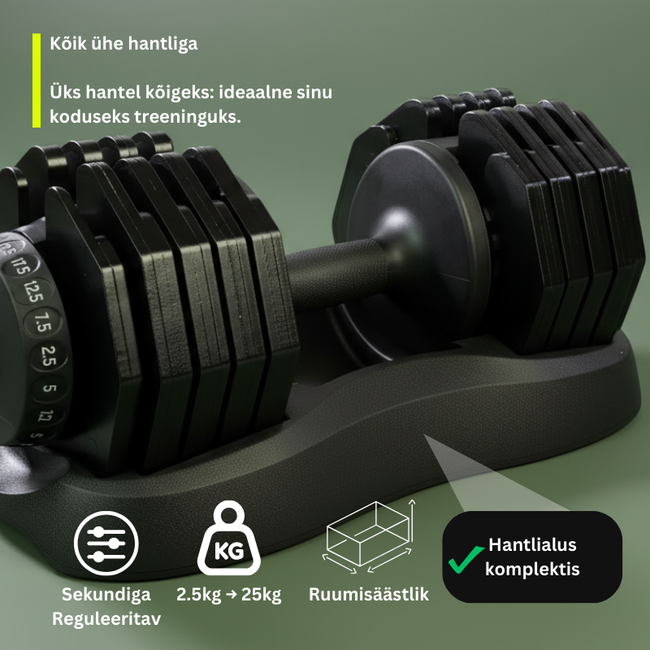
If you want to make things especially simple at home or in a home gym, two very practical options are:
- adjustable dumbbells 25 kg — saves space and changing weights is quick
- adjustable workout bench — provides more exercise variations and better support for presses and pulls
2) Cardio 2–4× a week or more, if preferred
Cardio helps expend energy and improves endurance. The best cardio is the one you actually do.
3) NEAT: daily movement is the “secret weapon”
NEAT refers to all movements that are not “exercise”: walking, stairs, cleaning, short walks.

If you exercise for 30 minutes but sit for the rest of the day, much of the potential is lost. But if you add a little movement throughout the day, the deficit accumulates much more easily.
7-day kickstart plan: simple, realistic, achievable
The point of this plan isn't “maximum pain.” The point is to prove to yourself that you know how to start.
Day 1: set one metric
Choose one:
- steps, e.g., 7000–9000 per day
- 3 meals a day without constant snacking
- each meal includes protein
Day 2: make one dietary change
Choose one swap:
- sugary drink → water or tea
- pastries → fruit + yogurt or curd cheese
- snacking → planned snack
Day 3: 30 minutes of walking
Do it in the morning, at lunch, or in the evening — but do it. If you're very busy, do 2×15 minutes.
Day 4: 20–25 min of strength training at home or in the gym
Example full-body workout:
- squats or sitting-standing on a chair 3×8–12
- push-ups against a wall or on the floor 3×6–12
- resistance band rows or dumbbell rows 3×8–12
- plank 3×20–40 seconds
Day 5: “simple plate”
Goal: every meal contains:
- protein
- vegetables
- one carbohydrate source, e.g., potato, rice, or whole grain product
Day 6: choose one “weak spot” and make a plan for it
Examples:
- evening sweet cravings → protein snack ready, e.g., curd cheese or yogurt
- stress eating → 10 minutes of walking before deciding
- weekend control → 1–2 agreements with yourself, e.g., alcohol only one evening
Day 7: summarize in 10 minutes
Ask yourself:
- What was surprisingly easy?
- What was difficult — and why?
- What one thing will have the biggest impact next week?
Pro Tip: If the plan seems too easy, don't make it harder. Do it for two weeks straight. Consistency beats the “perfect” plan.
Common mistakes that quickly turn “quick” into “back again”
- Starving and then overeating. Too many restrictions lead to a quick start but often no continuation.
- Only cardio + zero strength. After some time, the body may become softer, even if weight is lost.
- “All or nothing” mindset. One bad day doesn't mean the week is over.
- Ignoring sleep. When tired, appetite and impulses are more uncontrolled.
⚠️ When to talk to a doctor?
Talk to your family doctor or consult a specialist if:
- weight drops very quickly, and you feel persistent weakness or dizziness
- you have a chronic illness or are taking medications that affect weight
- you have symptoms or a history of eating disorders
- you experience chest or severe abdominal pain, fainting, or other acute symptoms
FAQ
How quickly can one lose weight healthily?
Healthy weight loss is typically about 0.5–1 kg per week. In the first few weeks, weight may drop faster as the body loses fluid in addition to fat. Too rapid weight loss is usually not sustainable and can increase the risk of fatigue, cravings, and overeating.
Is rapid weight loss dangerous?
It can be dangerous if calories are cut too low, food groups are eliminated, or one over-exercises. A healthier approach involves a moderate calorie deficit, sufficient protein intake, regular exercise, and good sleep. If you have a chronic illness, a history of eating disorders, or are taking medication, it's advisable to consult a doctor before starting.
What is a calorie deficit?
A calorie deficit means that you consume, on average, less energy than your body expends during the day. This is the fundamental principle of weight loss. A deficit doesn't have to mean starvation — it can be achieved through smaller portions, more mindful food choices, more steps, and regular exercise.
Do you need to count calories to lose weight?
No, but it can help. For some people, calorie counting provides a clear overview of where excess energy comes from. For others, a simpler approach works better: more protein, more vegetables, fewer sugary drinks, and more regular meals.
What to eat to lose weight but stay full?
A good choice is a combination of protein, fiber, and voluminous foods. For example, chicken, fish, eggs, curd cheese, Greek yogurt, legumes, vegetables, berries, potatoes, whole grain products, and salads help keep you full longer and make maintaining a deficit easier.
Does protein help with weight loss?
Yes, protein helps keep you full longer and supports muscle mass preservation during weight loss. If you eat enough protein and do strength training, you are more likely to lose more fat and less muscle.
Is strength training necessary for weight loss?
Strength training is not mandatory, but it is very beneficial. It helps preserve muscle mass, improves body shape, and supports metabolism. If you only do cardio and eat very little, weight may drop, but the body may become softer because some of the loss comes from muscle mass.
Is cardio or strength training better for weight loss?
The best is a combination. Cardio helps increase energy expenditure and improves endurance. Strength training helps preserve muscle and make the body stronger. In addition, daily movement, i.e., walking, stairs, and other activity outside of workouts, is very important.
What is NEAT and why is it important for weight loss?
NEAT stands for Non-Exercise Activity Thermogenesis, which includes all daily movements that are not structured exercise: walking, cleaning, taking the stairs, moving during work breaks, and other activities. This can be very important for weight loss because the accumulated movement throughout the day helps increase energy expenditure without having to do very long workouts.
Does walking help with weight loss?
Yes, walking is one of the simplest and most sustainable ways to increase energy expenditure. It's suitable for beginners, doesn't require special equipment, and is gentler on the body than very intense exercise. A good start might be, for example, 7000–9000 steps a day or 20–30 minutes of extra walking.
Can you lose weight without exercising?
Yes, weight loss is possible through diet alone if a calorie deficit is created. However, exercise helps improve body shape, maintain muscle mass, boost energy levels, and make the results more sustainable. Therefore, it is best to combine sensible nutrition and regular physical activity.
Why isn't my weight dropping, even though I'm exercising?
The most common reason is that calorie intake is still too high. Exercise burns energy, but it's easy to eat it back. Other factors may also play a role, such as lack of sleep, stress, fluid retention, weekend overeating, or too irregular eating habits.
Does eating in the evening make you fat?
Eating in the evening itself does not make you fat. Weight is affected by the average energy balance over the day and week. The problem arises when evening eating turns into uncontrolled snacking or a large caloric surplus. If an evening meal fits within your daily goals, it is not a problem.
Do carbohydrates need to be avoided for weight loss?
No. Carbohydrates do not hinder weight loss if overall energy intake is controlled. Potatoes, rice, whole grain products, fruits, and vegetables can be very good choices. It is better to reduce sugary drinks, sweets, and highly processed snacks.
How important is sleep for weight loss?
Sleep is very important. Lack of sleep can increase appetite, reduce self-control, impair recovery, and make exercise more difficult. If you want to lose weight healthily, try to sleep about 7–9 hours a day.
What to do if weight loss stalls?
First, look at the average over 2–3 weeks, not just one weight number. If your weight truly isn't moving, check your portion sizes, drinks, weekends, and daily activity. Often, a small change helps: 2000–3000 more steps per day, a slightly smaller portion, or more consistent protein intake.
Is a 7-day plan enough to lose weight?
7 days is a good start to get habits going. During this time, weight may shift a bit, but lasting results come over weeks and months. The most important thing is to continue with the same logic after the first week: a moderate deficit, higher protein diet, movement, and sleep.
When should you talk to a doctor about weight loss?
You should talk to a doctor if your weight is dropping very quickly, you feel constant weakness or dizziness, you have a chronic illness, you are taking medications that affect weight, or you have a history of eating disorders. You should also seek help if you experience severe pain, fainting, or other acute symptoms.
Next steps if you want to make it easier
If you want all of this to be less "trial and error" and more of a clear plan, do one of these:
- Calculate your daily target comfortably: Trenniekspert calorie calculator.
- If you want a more personalized approach where training and nutrition are combined, check out Trenniekspert's personalized training and nutrition plan.