If you have decided to start exercising or want to make your current routine more effective, then it is worth choosing workouts that help burn calories, maintain muscle mass, and improve overall fitness.
The right fat-burning workout is not just about sweating as much as possible. The best results come from a combination of strength training, cardio, daily movement, and sensible nutrition. If you want a broader overview of getting in shape, read also Trenniekspert's article how to get in shape easily and quickly in 2026.
In this article, we will look at five types of workouts that help support fat burning and get you in better shape for summer. These are suitable for both beginners and advanced individuals, as each workout can be adapted to your level.
Key Points
- Fat burning occurs in a calorie deficit — exercise helps expend energy, but diet determines a large part of the result.
- HIIT is time-efficient and suitable for those who want an intense workout in a short period.
- Strength training helps maintain muscle mass, which is very important during weight loss.
- Cardio improves cardiovascular health and helps increase weekly energy expenditure.
- Circuit training combines strength and endurance and is well-suited for home workouts.
- Swimming is joint-friendly and trains the whole body.
Before you start: fat burning doesn't depend solely on exercise
It's important to understand that no workout "burns fat" on its own if your total daily energy intake is consistently too high. Fat mass reduction occurs when the body expends, on average, more energy than it takes in from food and drink.
Therefore, exercise works best when combined with nutrition. For example, protein and fiber-rich foods help keep you feeling full longer and make a calorie deficit easier to achieve. If you want to improve your diet, also see the article 10 best carbohydrate sources for healthy eating.
International recommendations also emphasize consistency: the CDC recommends that adults get at least 150 minutes of moderate-intensity activity per week, plus at least 2 days of muscle-strengthening exercises.
Simple rule of thumb: the best fat-burning workout is the one you can do consistently. A perfect plan won't help if it only lasts for one week.

1. HIIT training — fast and effective fat burning
HIIT training, or high-intensity interval training, is one of the most time-efficient ways to increase exercise intensity. This means you alternate short periods of very intense work with short rest breaks.
One of HIIT's best-known benefits is the "afterburn effect," or EPOC. This means that after an intense workout, the body may consume more oxygen and expend more energy than usual for some time. Studies have shown that interval training can produce a significant EPOC effect compared to lower-intensity training, although its impact should not be overestimated (NCBI study on EPOC and interval training).
A typical HIIT workout lasts 15–30 minutes and can include exercises such as:
- burpees — 30 seconds work, 15 seconds rest;
- high knees — 30 seconds work, 15 seconds rest;
- jumping jacks — 30 seconds work, 15 seconds rest;
- mountain climbers — 30 seconds work, 15 seconds rest;
- jump squats or fast bodyweight squats.
As a beginner, start slowly: twice a week is perfectly sufficient. HIIT is intense, and doing it too frequently can quickly lead to overtraining for a beginner.
Tip: if you have joint problems or are just starting out, do lower-impact variations instead of jumping exercises, such as fast squats, step-ups, or stationary bike intervals.
2. Strength training for fat burning and muscle strengthening
Strength training for fat burning is often underestimated, as many associate weight loss only with cardio. In reality, strength training is one of the most important types of exercise if the goal is to improve body composition, i.e., reduce fat mass and maintain muscle mass.
Harvard Health emphasizes that during weight loss, a combination of resistance training, adequate protein intake, and a sensible rate of weight loss helps reduce excessive muscle mass loss. The Mayo Clinic also points out that regular strength training helps increase muscle mass, reduce body fat, and burn calories more efficiently (Mayo Clinic: strength training).
The most effective strength training exercises are usually compound exercises, as they engage multiple muscle groups at once:
- squats — train legs, glutes, and core muscles;
- deadlifts — engage back, legs, glutes, and grip;
- bench press — strengthens chest, shoulders, and triceps;
- rows and pull-ups — develop back and arms;
- lunges — improve leg strength and balance.
If you want to understand in more detail how to combine strength training and cardio for weight loss, read the article cardio training and strength training for weight loss.
A recommended start is 2–3 strength training sessions per week. Do 5–8 basic exercises, 2–4 sets, and about 8–12 repetitions per exercise. The last repetitions should be challenging, but the technique must remain under control.
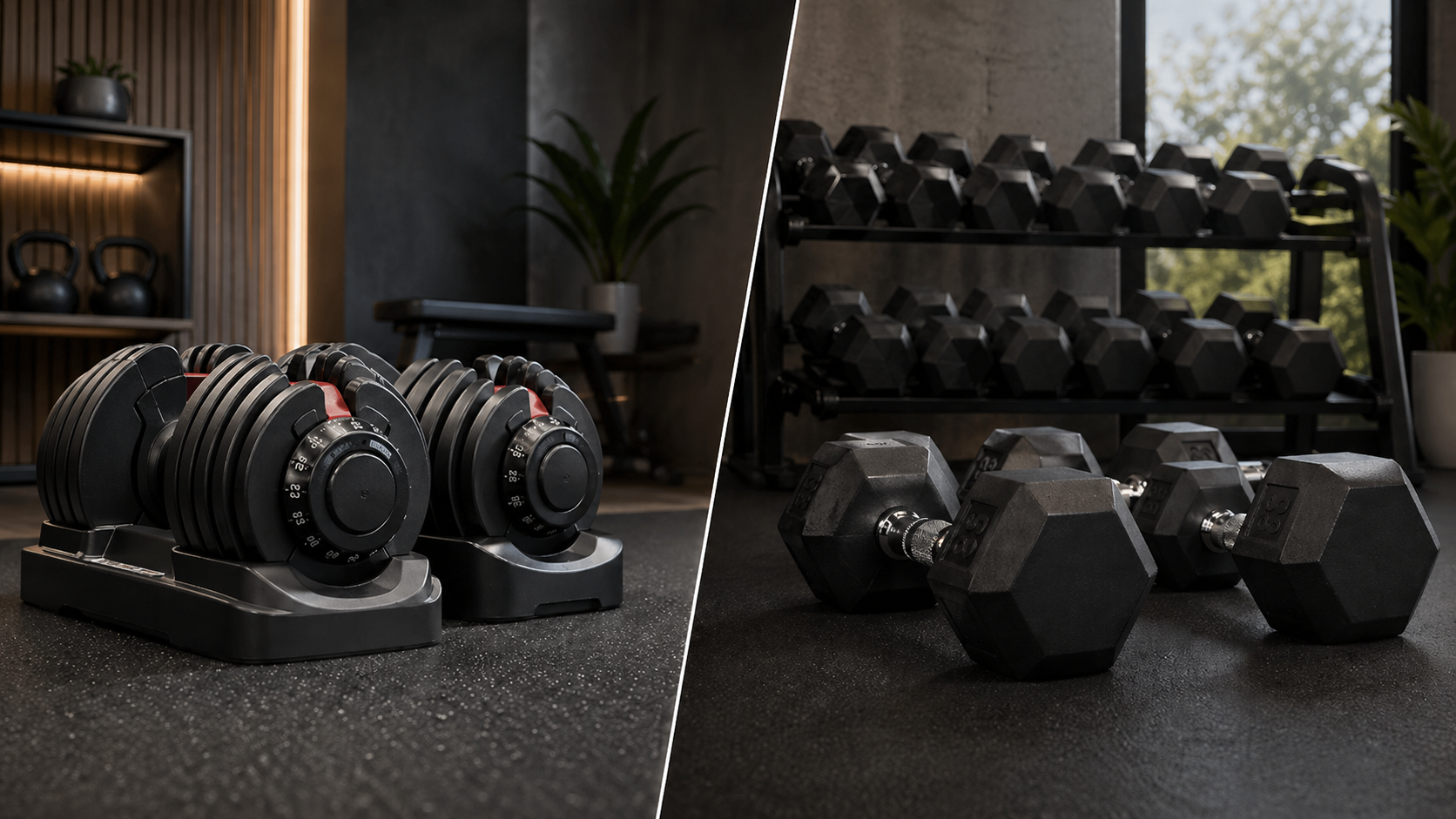
Practical recommendation: if you train at home, adjustable dumbbells, a training bench, and resistance bands are often sufficient to start. With these, you can do most full-body exercises.
3. Cardio training for maximum calorie burning
Cardio training is a classic and effective way to increase energy expenditure. While cardio may not have the same muscle-preserving effect as strength training, it helps improve endurance, heart health, and overall activity.
The CDC recommends that adults get at least 150 minutes of moderate-intensity aerobic activity or 75 minutes of high-intensity activity per week. This doesn't have to be done all at once — the training can be divided into several shorter sessions per week (CDC physical activity guidelines).
The most common forms of cardio to support fat burning are:
Running: a good way to improve endurance and increase energy expenditure. As a beginner, start by alternating walking and running.
Cycling: a more joint-friendly option that is also well-suited for those with higher body weight or knee problems.
Elliptical trainer: engages both the lower and upper body and has a lower impact than running.
Rowing machine: a very good full-body cardio device that engages legs, back, arms, and core muscles.
It's important to find a form of cardio that you genuinely enjoy. If you don't like running, you don't have to run — cycling, swimming, an elliptical trainer, or brisk walking can be equally practical choices.
4. Circuit training — versatile and time-efficient
Circuit training combines the benefits of strength and cardio training. Typically, 6–10 exercises are performed in sequence with short breaks in between. This keeps the heart rate elevated while also stressing the muscles.
Circuit training is well-suited for those who want a full-body workout in 20–30 minutes. It's also a good choice for home workouts, as many exercises don't require special equipment.
Key benefits of circuit training:
- burns a lot of energy in a short time;
- improves both strength and endurance;
- keeps the workout varied and interesting;
- suitable for home, gym, or outdoor use;
- exercises can be adapted to your level.
Sample circuit training for beginners: do 3–4 rounds, 40–45 seconds per exercise, and rest 15–20 seconds between exercises.
- squats;
- push-ups or knee push-ups;
- jumping jacks or low-impact step-ups;
- plank;
- lunges;
- mountain climbers;
- abdominal exercises;
- high knees or fast walking in place.
Tip: if you're working out at home, keep circuit training simple. Choose exercises you can do with correct form, and only increase intensity when your base is solid.

5. Swimming — full body workout in water
Swimming is often underestimated but is a very good workout for fat burning and improving endurance. It is especially well-suited for people who want less strain on their joints but still want a proper full-body workout.
Swimming engages the legs, arms, back, core muscles, and respiratory system. In addition, it can be a good change for those who quickly get bored with traditional gym workouts or running.
Benefits of swimming:
- trains the entire body;
- is gentler on joints than many high-impact workouts;
- improves heart and lung function;
- suitable for people of all ages and fitness levels;
- helps diversify your workout routine.
Different swimming styles offer different levels of exertion:
- freestyle — good for general endurance training;
- breaststroke — places more load on the legs and core muscles;
- backstroke — well-suited for back and shoulder girdle work;
- butterfly — a very intense style, more suitable for advanced swimmers.
Start with 20–30 minute swimming workouts 2–3 times a week. You can alternate slower paces with faster intervals to make the workout more like interval training.
How to choose the best fat-burning workout for you?
The best choice depends on your goal, time, fitness level, and preferences. All five workout types can work if done consistently and combined with sensible nutrition.
| Workout | Best suited for | Main benefit |
|---|---|---|
| HIIT | Exercisers with limited time | Short and intense workout |
| Strength Training | Improving body composition | Helps maintain muscle mass |
| Cardio | Increasing endurance and energy expenditure | Easy to start and monitor |
| Circuit Training | Quick full-body workout | Combines strength and cardio |
| Swimming | Joint-friendly workout | Full-body load with less impact |
If you're a beginner, start with 2–3 workouts a week and add daily movement. If you've already been training, you can combine, for example, 2 strength training sessions, 1 HIIT session, and 1–2 calmer cardio sessions per week.
If you want to choose a suitable exercise for your child, also check out Trenniekspert's articles 5 best sports for child development and safety and children's workouts in Tallinn.
Summary: getting in shape for summer starts with consistency
Getting in shape for summer doesn't have to be extreme or complicated. HIIT, strength training, cardio, circuit training, and swimming all offer different ways to support fat burning. The most important thing is to choose a workout that you can do regularly.
Remember that exercise is only one part of the whole. For results, you also need enough sleep, sensible nutrition, and general activity. When these three things support your training, the results become much more realistic.
Spring is the ideal time to start. Choose one or two types of exercise, set a realistic weekly plan, and take the first step today.
Final recommendation: don't look for one "magical" fat-burning workout. Combine strength training, cardio, and daily movement, and do it consistently for at least 6–8 weeks.
Frequently Asked Questions
How often should I work out to see results?
For beginners, 3 workouts a week are enough. Advanced exercisers can train 4–5 times a week, but it's important to allow the body time to recover. In addition to workouts, daily movement, such as walking, helps improve results.
Which workout burns the most fat?
No single workout burns fat independently if there is no calorie deficit. HIIT can be very effective in a short period, strength training helps maintain muscle mass, and cardio helps increase energy expenditure. The best results come from combining them.
Is exercise alone enough for weight loss?
Theoretically, it can be enough if exercise creates an energy deficit. In practice, nutrition is very important because calories burned through exercise are easily replaced by food. Therefore, the best results come from a combination of exercise and conscious nutrition.
How quickly can results be seen?
The first changes in energy levels and well-being can appear within a couple of weeks. Visual changes usually occur in 6–8 weeks if training and nutrition are consistent.
Is HIIT suitable for beginners?
Yes, but a beginner should start with lower intensity and simpler exercises. For example, instead of jumps, one can do step-ups, brisk walking, stationary bike, or low-impact bodyweight exercises.
Does strength training make you too bulky during weight loss?
No. Strength training rather helps preserve muscle and make the body more toned during weight loss. Building large muscle mass usually requires long-term training, adequate nutrition, and progressive overload.
Is cardio or strength training better?
They serve different roles. Cardio helps improve endurance and increase energy expenditure. Strength training helps maintain muscle and improve body composition. For fat burning, it is most sensible to combine them.
Does swimming help lose weight?
Yes, swimming can help with weight loss if it helps increase energy expenditure and supports a calorie deficit. The advantage of swimming is that it puts less strain on the joints and works a large part of the body at once.
How long should a fat-burning workout last?
It depends on the type of workout. HIIT can last 15–30 minutes, strength training 40–60 minutes, and calmer cardio 30–60 minutes. As a beginner, consistency is more important than workout length.
What to do if motivation drops?
Reduce the complexity of the workout and focus on a small goal, such as 20 minutes of movement a day or 3 workouts a week. Motivation fluctuates, but habit and a simple plan help to continue even when the mood isn't ideal.
Sources
- CDC. Adult Physical Activity Guidelines.
- NCBI. Interval exercise and excess post-exercise oxygen consumption.
- Harvard Health. Trying to lose weight? Be careful not to lose muscle.
- Mayo Clinic. Strength training: Get stronger, leaner, healthier.
- Trenniekspert.ee. How to get in shape easily and quickly in 2026.
- Trenniekspert.ee. Cardio training and strength training for weight loss.
- Trenniekspert.ee. 10 Best Carbohydrate Sources for Healthy Eating.